Posts

Open Source Networking: a hierarchical approach
Image
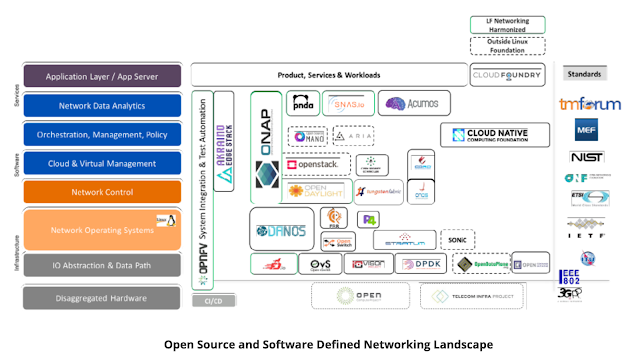
I have been extremely fortunate to be part of several network cloudification projects over the past 18-24 months.  It's been very exciting to see the changes that disaggregation and open source projects have been making to move an industry forward.  Here I capture some initial thoughts about open source networking. Note: while the on-the-job learning has been immense, I have supplemented this with some terrific courses from The Linux Foundation including LinuxFoundationX: LFS165x Introduction to Open Source Networking Technologies by Reza Toghraee. Networking has come a long way from the widespread use of rigid appliances to perform networking functions such as routing, firewalling, switching, and load balancing.  A key principle behind this transformation is disaggregation , i.e. the de-coupling of the software performing the networking functions with the hardware it is installed on.  The main driver of this transformation ...

Curious about 5G?

Image
Are you curious about 5G but not sure what it's all about?  Here's a quick summary to bring you up to speed. A quick refresher about 1G through 4G before we get started: 1G refers to the first generation of wireless cellular technologies that brought us our very first cell phones. 2G was a significant improvement from 1G in the way the radio frequency spectrum was used enabling many more users per frequency band.  Importantly for consumers, 2G enabled digitally encrypted conversations and SMS text messages! 3G was a giant leap forward from 2G.  3G enabled consumers to get online using their cell phones. 4G pushed the limits further with improved speeds and increased applications for consumers including IP telephony, high def mobile TV and video conferencing.  So what does 5G promise?  5G promises to dramatically improve speed, latency and scale. It is expected to be 100X faster than 4G (you could download an HD movie in 1 second!). Its data volume...

AI, ML, NN and DL: a visual explanation

Image
There appears to be a lot of confusion between the terms Artificial Intelligence (AI), Machine Learning (ML), Neural Networks (NN) and Deep Learning (DL).  Based on research from various popular blogs and articles, here is my attempt at a simple visual explanation:

The Research Process

Image
To answer interesting questions, you need data. You begin with an observation that you want to understand including anecdotal observations.  For example, a certain website layout attracts more visitors to our web page than a different website layout.  From your observations, you generate explanations or theories of those observations, from which you can make predictions or hypothesis.  To test your hypothesis or predictions, you need data. So you collect relevant data (and to do that you need to identify things that can be measured) and then you analyze those data.  The analysis of your data may support your theory or give you cause to modify the theory. As such, the processes of data collection and analysis and generating theories are intrinsically linked: theories lead to data collection / analysis and data collection / analysis informs theories.  The research process is summarized below: (adapted from Discovering Statistics using R by Andy Field e...

Operationalize Trusted AI with IBM Watson OpenScale

Image

Satellite imagery and remote sensing puzzles

Image
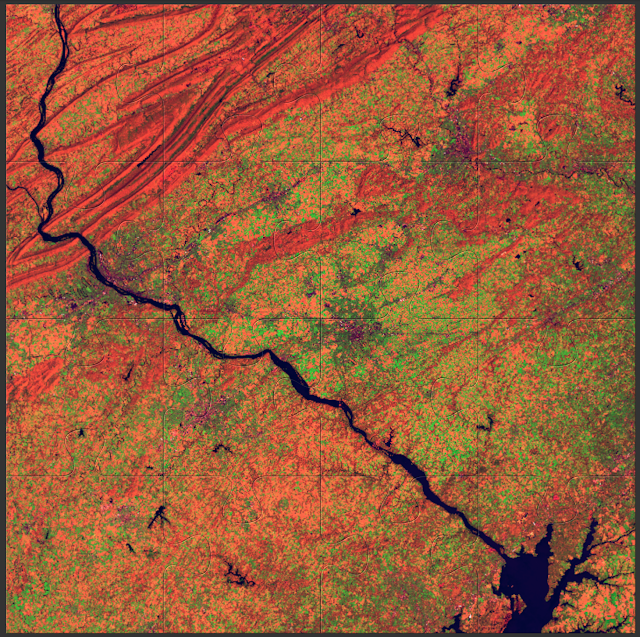
If you are looking for a fun way to experience satellite imagery and learn more about remote sensing, check out Earth Image Puzzles here . Here is a solved jigsaw puzzle of SouthEastern PA: Enjoy!

The world of languages

Image
Courtesy of: Visual Capitalist